
A freshly washed car can look immaculate — until you look at the wheels. That dark, grey-black coating on the rims is brake dust, and it has a frustrating habit of returning almost as soon as it is cleaned. A quick pass with a wash mitt and ordinary car shampoo rarely moves it. There is a good reason for that. Brake dust is not ordinary road dirt, and removing it properly depends on chemistry rather than water pressure alone. For distributors, auto-care retailers and detailing shops, understanding what brake dust is, why it bonds to the wheel, and how different wheel cleaners release it is the difference between a product that performs and one that generates complaints or damaged-wheel claims.
What Brake Dust Actually Is
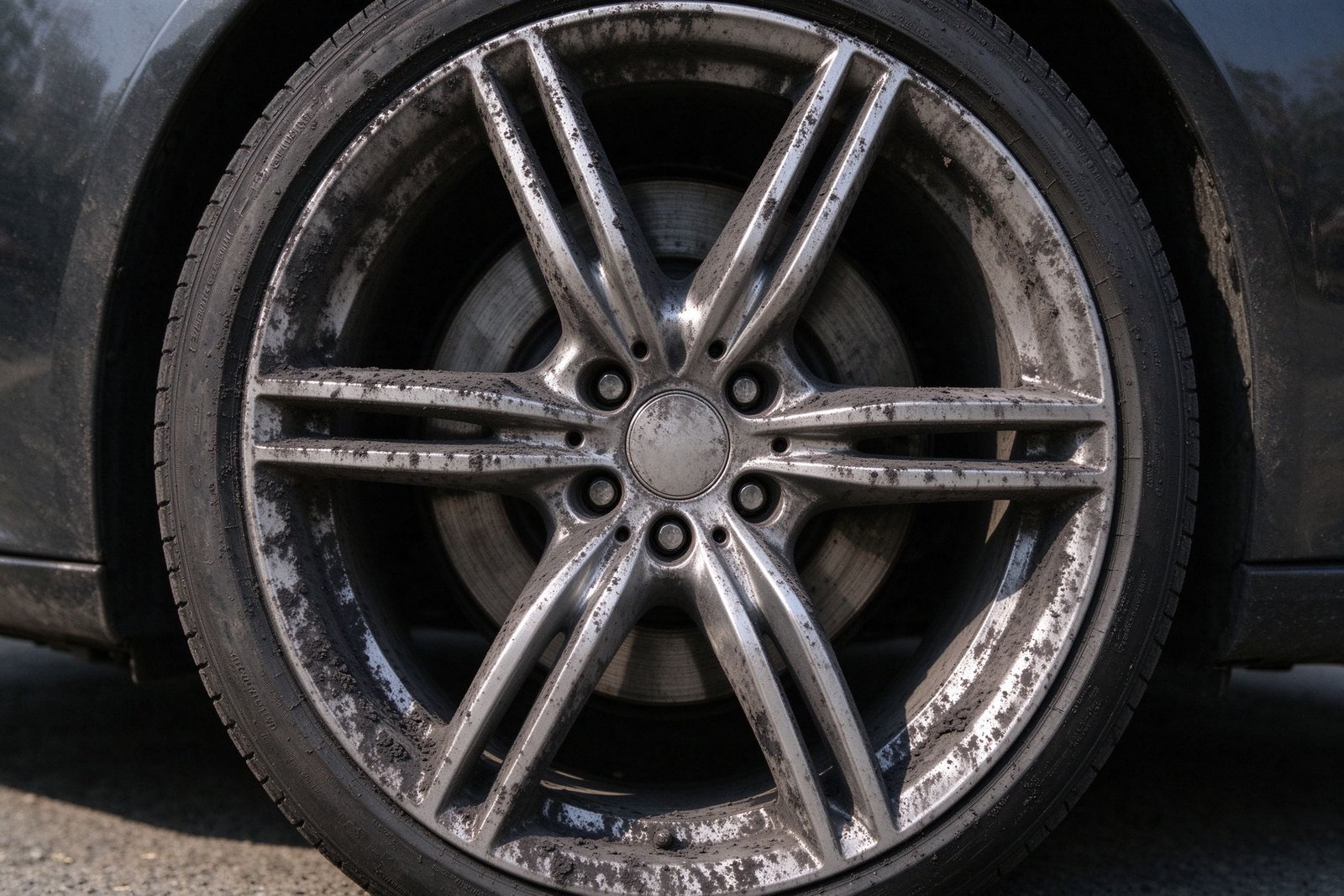
Every time a disc brake is applied, the brake pad is squeezed against a cast-iron rotor to convert the vehicle’s kinetic energy into heat. Both surfaces wear, and microscopic particles are shed and thrown outward toward the wheel. The exact composition depends on the pad formulation, but brake dust is typically a mixture of: iron and steel particles worn from the rotor and from metallic fibers in the pad; carbon and friction dust, including graphite used as a lubricant; mineral abrasives and fillers, such as ceramic or metal oxides; cured phenolic binder residues; and in some heavier-duty formulations, copper or brass fibers (environmental rules in a growing number of markets are pushing formulators toward low- and no-copper friction materials).
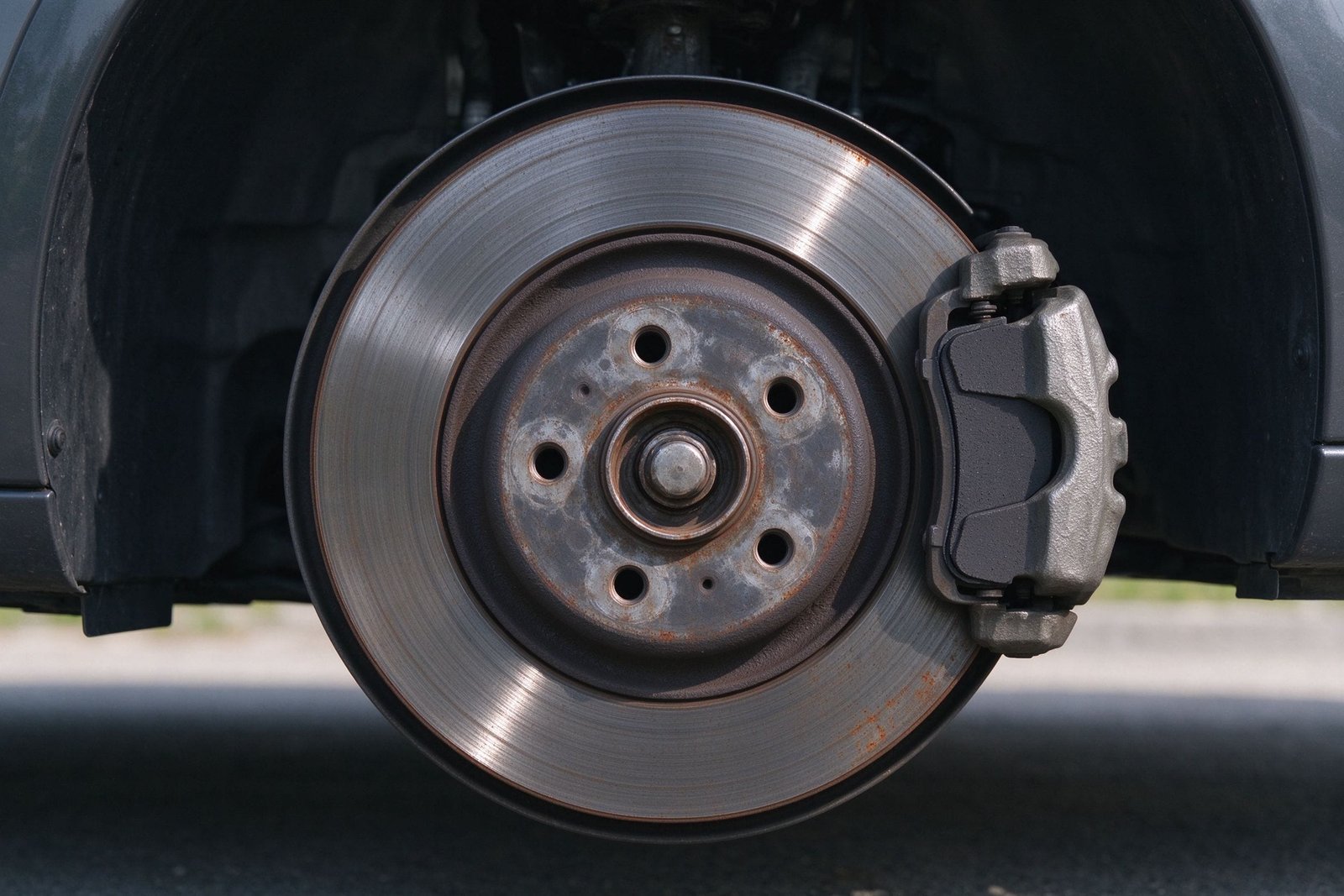
Most of this material comes from the front axle, because the front brakes typically supply roughly 70–80% of a vehicle’s stopping force — which is why front wheels darken first. The particles leave the contact area at high temperature; during hard or repeated braking, rotor and pad surfaces can reach several hundred degrees Celsius, and the dust is effectively heat-bonded by the time it lands.
Why It Sticks — and Why Soap and Water Fail
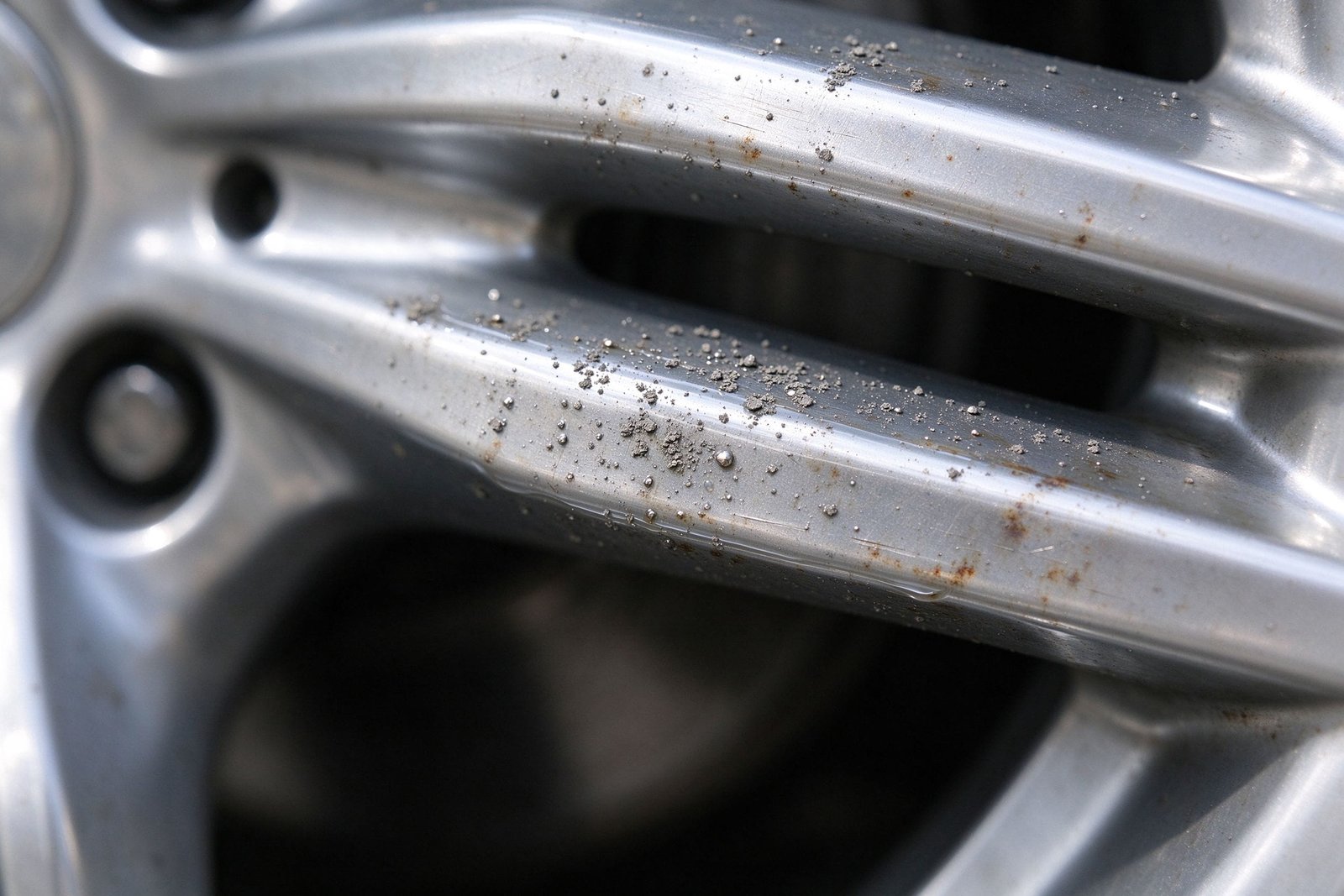
Several mechanisms work together to make brake dust stubborn:
- Heat bonding and embedding. A wheel’s clear coat is not perfectly smooth at the microscopic level. Hot particles can soften the finish and become partially embedded or sintered onto the surface as it cools.
- Oxidation and mechanical anchoring. The iron fraction rusts into iron oxides. Oxidation expands the particles and locks them into the texture of the coating — the same reason rust cannot simply be wiped away.
- Electrostatic attraction. Friction and rotation generate static charge, which helps the fine particles cling.
- A binding film of road grime. Oil, grease, tire dressing and road film mix with the dust and glue it in place.
The key point for cleaning: the metallic and mineral fraction does not dissolve in water, and a neutral car shampoo is designed to lift light, loosely bonded or oily traffic film — not sintered metal. That is why high-pressure water and suds leave the grey-brown layer behind.
How Wheel Cleaners Work: Two Chemistry Routes
Professional wheel products generally rely on one of two chemistries, sometimes combined.
1. Alkaline wheel cleaners and degreasers
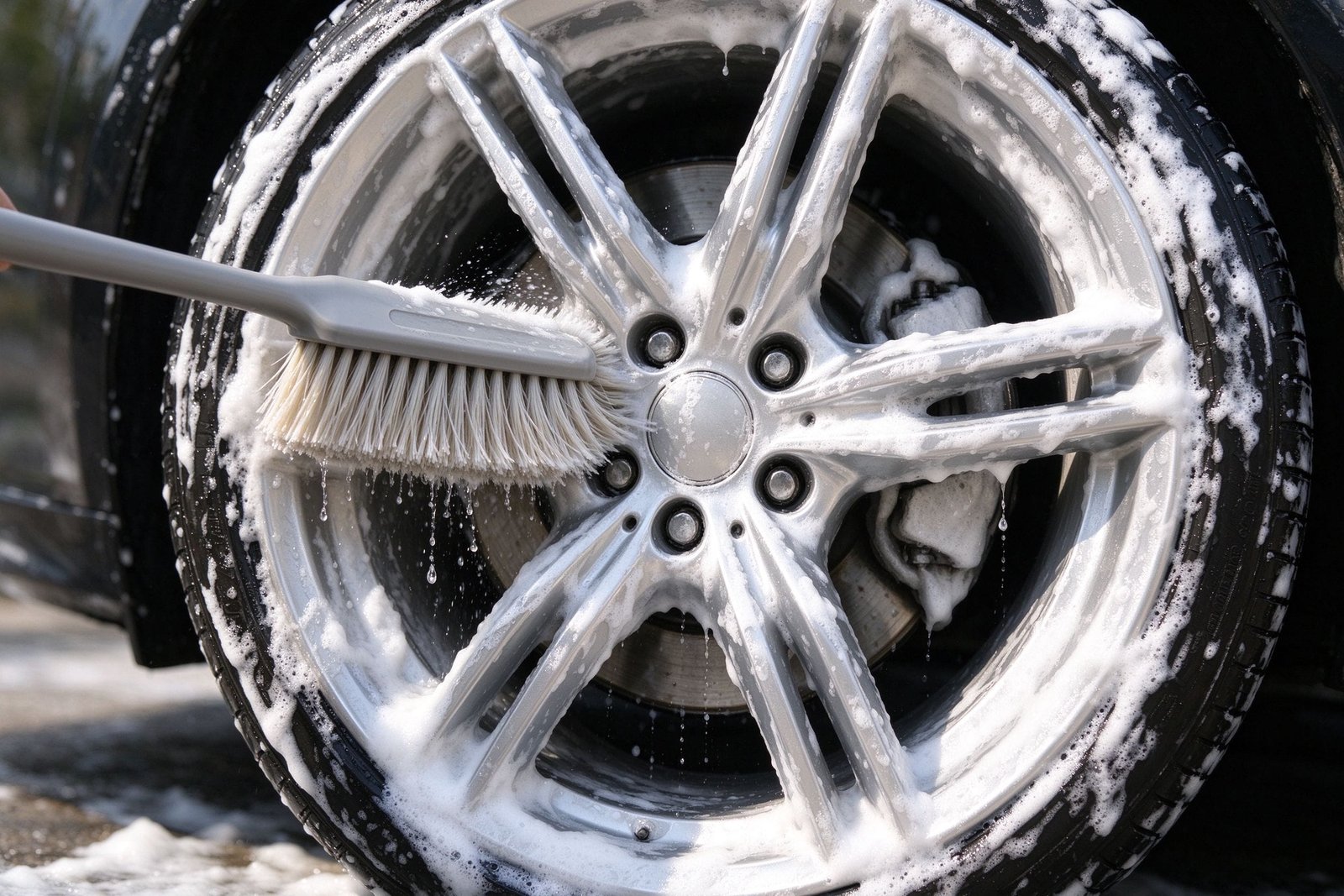
Alkaline cleaners combine high-pH builders, wetting agents and surfactants, often with chelating (sequestering) ingredients, and attack the problem on several fronts:
- Wetting — surfactants lower surface tension so the product penetrates under and around the particles instead of beading on top.
- Saponification and emulsification — alkalinity converts greasy, oily deposits, including binder and road film, into soap-like, water-rinsable compounds and emulsifies them.
- Chelation — sequestering agents bind metal ions such as iron, calcium and magnesium, loosening mineral soil and keeping particles suspended so they do not re-deposit.
- Dispersion — the bonded layer is broken into fine particles that can be flushed away.
Alkaline products are especially effective on steel wheels and heavily soiled commercial vehicles. Because high pH can attack sensitive surfaces — anodized, polished or uncoated metals and some aftermarket coatings — concentration, dwell time and thorough rinsing matter, and the product should be kept off hot wheels.
2. Iron and fallout removers (the “color-change” products)
These products target the iron fraction directly. They typically use sulfur-based reducing/chelating agents (thioglycolate/mercaptoacetate chemistry is common). The active molecules form a soluble, strongly colored complex with iron — the characteristic red, purple or almost black “bleeding” effect — converting insoluble iron and iron oxide into something that can be rinsed off. The color change is a visible sign that the reaction is taking place. Iron removers are usually near-neutral and are often preferred for coated alloy wheels, where a strong alkaline product would be risky. As with any wheel cleaner, they should not be allowed to dry on the surface.
Matching chemistry to the wheel
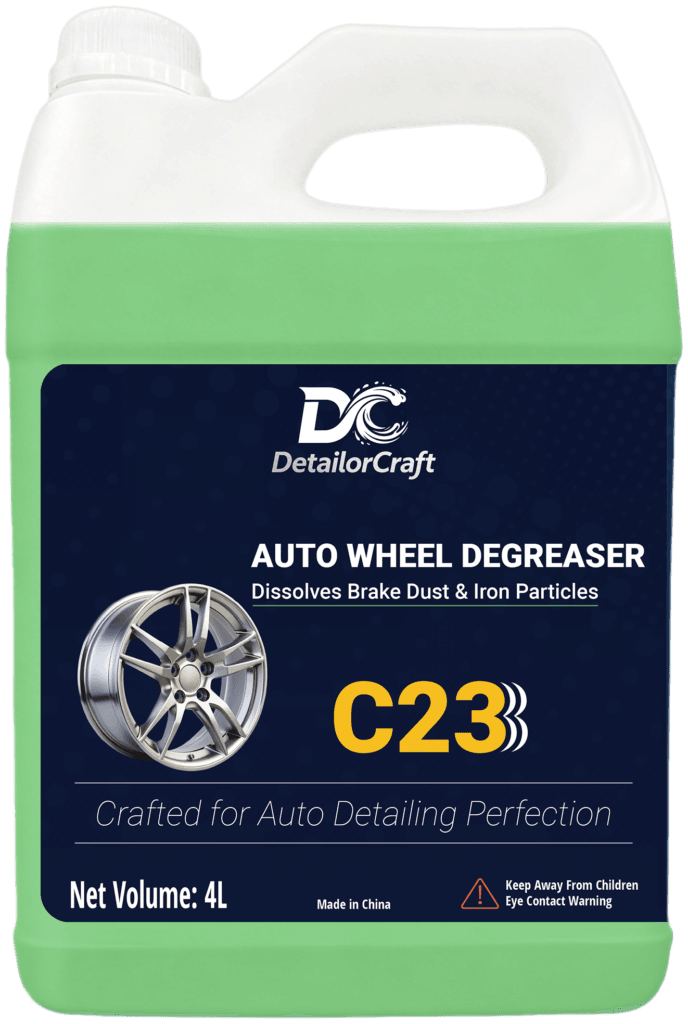
Steel wheels, fleets, heavy grease and baked-on dust — a concentrated alkaline wheel degreaser is cost-effective and powerful. Coated alloys and sensitive finishes — a near-neutral iron-removal approach reduces risk. When in doubt — test on an inconspicuous area first and follow the label. DetailorCraft’s C23 Auto Wheel Degreaser sits in the first group — an alkaline concentrate formulated to dissolve brake dust and iron particles, intended for automotive steel wheels and tires, and designed to be applied diluted and rinsed with pressurized water.
Why This Matters for Distributors, Retailers and Detailers
Matching the product to the wheel prevents damage claims and returns; selling a strong alkaline cleaner for polished or anodized rims creates avoidable liability. Concentrated, dilutable products lower cost per wheel — C23 is used at roughly a 1:10 dilution (higher concentration for heavy-duty grime), so one container yields a large volume of working solution. Being able to explain why a product works supports the sale and helps end users. Clear labeling, pH guidance and personal-protection advice keep the business aligned with safety and compliance expectations.
Best-Practice Application
- Work on cool wheels, out of direct sunlight, and never let the product dry.
- Pre-rinse to remove loose material.
- Dilute as directed — about 1:10 for C23, stronger for severe soiling.
- Apply, allow the labeled dwell time, and agitate with a suitable brush where needed.
- Rinse thoroughly with pressurized water.
- For any non-steel or uncertain wheel, test a small area first; wear gloves and eye protection, store indoors at ambient temperature, and keep the product away from children.
Conclusion
Brake dust is difficult because it is a hot, metallic and mineral-rich deposit that becomes embedded, oxidized and bonded to the wheel — exactly the kind of soil that water and ordinary shampoo cannot remove. Alkaline wheel degreasers release it through wetting, saponification, emulsification, chelation and dispersion, while iron removers convert the metal fraction into a soluble, rinsable complex. Using the right chemistry for the wheel protects both the finish and the business. Distributors, auto-care chains, retailers and private-label buyers can request details and samples of the C23 Auto Wheel Degreaser — a concentrated, dilutable alkaline product available for wholesale and OEM branding — through our 获取报价 page.